On Monday, I drover the golf cart the whole morning and then in the afternoon we went into Portland for a Portland underground tour. It was very interesting. They talked about the bad guys in Portland history and the flooding in Portland history. The only think I didn't like about it was that I thought I would be walking through tunnels but really I walked through a couple basement rooms. Overall it was very interesting.
On the way home we stopped at the grocery store and got dinner and chicken livers so I could make chicken liver pate. When we got home I drover the golf cart some more.
19.4.10

17.4.10
Trip to Oregon Day 3

Sunday was probably the best day. It started off with a dune buggie ride on sand dunes and by the way we were going 60 MPH. We were doing that for about 1 hour. Then, we had lunch on the water. When we were done eating we left to see my dad's cousin's daughter, in Eugene. We got to Eugene just fine but once we were in Eugene things started to go wrong. We were following my grandpa's car because it had a GPS in it but the GPS was taking us in the wrong direction but finally after being in Eugene for 30 minutes we finally found her house. We were at her house for about 30 minutes then we left for Portland (we didn't have trouble getting out of Eugene). For dinner we had beef tacos at my uncle's house and a postprandial bond fire.
Trip to Oregon Day 2

 On Saturday, we started our road trip to the Oregon coast. It took us about 2 hours and 30 minutes to get to lunch on the coast. Then, we drove another 30 minutes to our hotel. We unpacked at the hotel and then we drove to the beach. THE WATER WAS COLD! When we got tired of the beach we came back to the hotel and we went swimming in the indoor pool. Then, I learned a card trick that I forget. Then, I go back to the indoor swimming pool.
16.4.10
Trip to Oregon Day 1

 Last Friday, I left on a trip to Oregon. This wasn't just a regular trip but it was my first trip flying alone.
I left San Jose international airport around 10:00 AM and I got to Portland around 12:00 PM. In Portland my grandparents picked me up at the airport and took me about a half hour south of Portland to their house. The first thing was lunch at a Japanese restaurant. Then it was driving the golf cart, around their neighborhood and we stopped at the country club to play a baby grand piano. It sounded very good. Then we went to my cousin's horse riding lesson. After that she slept over for the night. It was a long night because she couldn't settle down but finally she did.
8.4.10

Hanging out in San Fransisco

 On Saturday, I felt like going to my 3rd favorite the city. We went to the European bookstore. We got 2 books, Les récrés du petit nicolas and Le Château de ma mère. Then, we walked around in the Union square area. For lunch, we ate at House of Nanking. It was great! I had scallops. There was a picture of Jamie Oliver on the wall. After lunch, I sat down in the same spot and we took a picture. Usually I eat with CT in Chinatown but not this time, it was probably to early... noon


29.3.10
Dreams Sometimes do Come True
For years I have been wanting to write an essay about the history of my house and here it is.
Early history of the house and property is based on research that I did at the (...) Library’s City Room, using the Sanborn maps collection and old city directories. I think the house was built around 1890. According to historical documents, we discovered that the property used to be the swine pasture for pigs kept by Mission (...) which is about (...). Then it was purchased by J.H. Morse, who planted fruit trees in the fertile ground. Originally, there were three structures on the property: the house, a horse barn and a two-story carriage house where the carriage man lived. From 1910 to 1914 the house was occupied by the Moorhead family (very big family). This 1911 photo shows Melbourne Moorhead as a boy on the front steps. From 1915 to 1926 the house belonged to the Bauer family (another big family). Then Axel Carlson got a building permit worth $475 on June 27, 1926 to convert the house into a two family house.
The second phase of history of my house on (...)– 1930-1978 – is called the two-family phase because, according to the census reports, one family lived upstairs and another family lived downstairs. Each apartment was very small. From 1932 to 1964, the house belonged to Alfred F. Purdy, a pharmacist, who lived downstairs, and he rented out the upstairs apartment to many tenants including a printer, a nurse, a shoe repairman and a salesman. In 1960, his son Dore, a clerk at Johnson & Johnson, inherited the house. Several years later Dore sold the house to Mrs. Marcella Hendry and she rented the upstairs to Mrs. Marcella Martin. In 1969, the house was vacant and then sold to Philip J. Jimenez. In 1970, the downstairs was occupied by D.C. McCavitt. From 1970 to 1978, the occupants of the house changed every year. Then in 1978 it was sold to (...) who began to convert it back to its original condition as a single residence.
Since 1978, (...) took out the kitchen from the upstairs bedroom, he removed an outside staircase going to the second floor and took out doors. In 1996, (...) bought the house. He put in a new kitchen, two bathrooms, sunroom addition, built a huge deck, put on a new roof and paved the driveway. In 2003 my family bought the house from the (...). First, we took out the carpet, removed lots of wallpaper, painted the walls, and replaced some windows. In 2007, we built a new garage and guest house that looks like an old barn.
My house is nearly 120 years old and there will always be lots of work to do on it. But it has survived several big earthquakes, conversion to and from a two-family house, and the wear and tear of dozens of owners and renters. There are other Painted Lady Victorian houses in the neighborhood but mine is one of the best!
My grade on that project is "E" (the best).
My Painted Lady
My house – an old “Stick” Victorian house in (...), California has a lot of history. The house is a Victorian farmhouse design which is typical of California houses built at the end of the 1800’s. These Victorians were called “Painted Ladies” because they were painted lots of bright colors, like my house now. This report covers three time periods: the early history (c. 1890-1930), middle history (1931- 1978) and modern history (1979 to today).
Early history of the house and property is based on research that I did at the (...) Library’s City Room, using the Sanborn maps collection and old city directories. I think the house was built around 1890. According to historical documents, we discovered that the property used to be the swine pasture for pigs kept by Mission (...) which is about (...). Then it was purchased by J.H. Morse, who planted fruit trees in the fertile ground. Originally, there were three structures on the property: the house, a horse barn and a
 two-story carriage house where the carriage man lived. From 1910 to 1914 the house was occupied by the Moorhead family (very big family). This 1911 photo shows Melbourne Moorhead as a boy on the front steps. From 1915 to 1926 the house belonged to the Bauer family (another big family). Then Axel Carlson got a building permit worth $475 on June 27, 1926 to convert the house into a two family house.
The second phase of history of my house on (...)– 1930-1978 – is called the two-family phase because, according to the census reports, one family lived upstairs and another family lived downstairs. Each apartment was very small. From 1932 to 1964, the house belonged to Alfred F. Purdy, a pharmacist, who lived downstairs, and he rented out the upstairs apartment to many tenants including a printer, a nurse, a shoe repairman and a salesman. In 1960, his son Dore, a clerk at Johnson & Johnson, inherited the house. Several years later Dore sold the house to Mrs. Marcella Hendry and she rented the upstairs to Mrs. Marcella Martin. In 1969, the house was vacant and then sold to Philip J. Jimenez. In 1970, the downstairs was occupied by D.C. McCavitt. From 1970 to 1978, the occupants of the house changed every year. Then in 1978 it was sold to (...) who began to convert it back to its original condition as a single residence.
Since 1978, (...) took out the kitchen from the upstairs bedroom, he removed an outside staircase going to the second floor and took out doors. In 1996, (...) bought the house. He put in a new kitchen, two bathrooms, sunroom addition, built a huge deck, put on a new roof and paved the driveway. In 2003 my family bought the house from the (...). First, we took out the carpet, removed lots of wallpaper, painted the walls, and replaced some windows. In 2007, we built a new garage and guest house that looks like an old barn.
My house is nearly 120 years old and there will always be lots of work to do on it. But it has survived several big earthquakes, conversion to and from a two-family house, and the wear and tear of dozens of owners and renters. There are other Painted Lady Victorian houses in the neighborhood but mine is one of the best!
My grade on that project is "E" (the best).
28.3.10
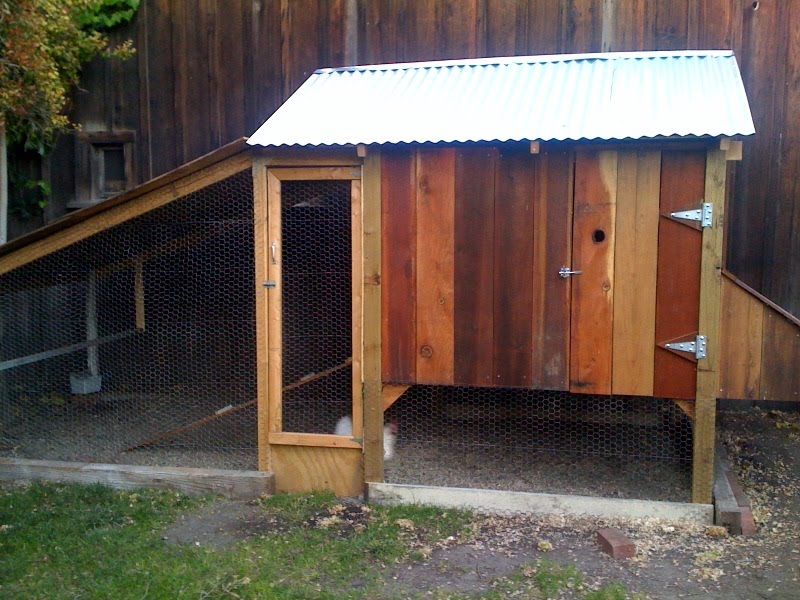
Chicken Coop 3


Today and for the past week we've been working like mad on the new chicken coop and finally today we got the human door on and the two egg box doors on. Now it acts and looks like a real chicken coop. So far it costs less than $ 350. Here are some photos.
21.3.10
HALFPIPE!

At the terrain park at Sierra at Tahoe last Sunday. You can't really see how high it is but it was about 2 stories high.
The departement of education?
Why does the department of education have 14 inch barrel shotguns and want more? By the way under 18 inches is illegal to the public. I wonder what other departments have? Tanks? I do not think that the department of education should have guns and especially illegal shotguns. Here are som links to some newspapers about this subject: http://www.mcclatchydc.com/2010/03/12/90315/agency-places-shotgun-order-fbi.html
http://voices.washingtonpost.com/answer-sheet/education-secretary-duncan/ed-department-buying-27-shotgu.html?hpid=sec-education
http://voices.washingtonpost.com/answer-sheet/education-secretary-duncan/ed-department-buying-27-shotgu.html?hpid=sec-education
Subscribe to:
Posts (Atom)
